Family follow-on · the family-follow-on route for refugees, governed by Vw 29(1)(c) and Vw 42
Family follow-on is the procedure by which family members of a recognised refugee or subsidiary-protection holder in the Netherlands apply to join them. The decision-term under Vw 42 is six months. Once the term has passed without a decision, the applicant can serve a Notice of Default citing Vw 42 and Awb 4:17. The IND then has 14 days to decide. If they do not, the daily penalty starts to run and the route to court under Awb 6:12 opens. Most stuck family follow-on files move once the Notice is served, because the IND must close the file or face escalation.
Family follow-on · the family-follow-on route for refugees, governed by Vw 29(1)(c) and Vw 42
Nareis (literally "following-on") is the procedure under Vw 29(1)(c) by which the spouse, registered partner, minor children or, in narrow cases, other dependent family members of a person with an asylum permit in the Netherlands can apply for a permit to join. The application is filed at the Dutch embassy or consulate in the country of residence (or, for stateless persons or those in third countries, at a designated representation). The IND in the Netherlands processes the decision.
Vw 42 fixes the IND's decision-term on asylum-based applications at six months. Family follow-on is technically a family-of-asylum-holder route, which sits under Vw 42's umbrella because it derives from the asylum-status of the sponsor in the Netherlands. The clock starts on the day after the embassy or the IND receives the complete application.
Six months. Counted from receipt of the complete file. Day one is the day after receipt. The clock does not stop because the case is at the embassy stage rather than the IND stage — Vw 42 applies to the whole family follow-on procedure.
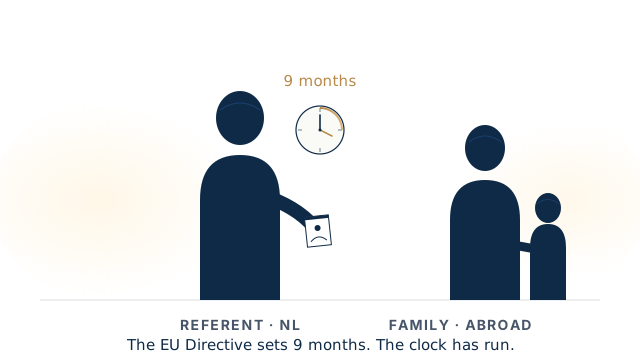
Article 31(3) of the EU Asylum Procedures Directive (2013/32/EU) allows extension of the six-month term by up to nine months on grounds of complexity, mass arrivals or the need for further investigation. The Netherlands has implemented this in Vw 42(4), so the maximum is fifteen months. The extension must be communicated to the applicant before the original six months expires.
The Notice of Default (ingebrekestelling) is the procedural lever. It is a single page, sent by registered mail to the IND, citing Vw 42 and Awb 4:17, identifying the case by V-number and giving the IND fourteen days to decide. The Notice does not argue the substantive case; it forces the procedural step. Most stuck family follow-on files move once the Notice is filed — either the IND issues the decision (most cases) or they triggers the daily penalty and the Awb 6:12 fictive-refusal route to court (rarer).
The daily penalty under Awb 4:17 starts on day 15 after the Notice and runs at €23 per day for the first 14 days, €35 per day for the next 14 days, and €45 per day for the remaining 14 days, capped at €1,442 in total. The IND pays this to the applicant once the decision-period is over or a decision is issued. Most cases do not reach the daily penalty because the IND decides within the 14-day window.
Family follow-on files are a high-share of our caseload. The substantive case (proving the family relationship, the asylum-status of the sponsor, the integrity of the documentation) belongs with VluchtelingenWerk Nederland or a specialised lawyer (advocaat). Our role is procedural: when six months have passed without a decision and no valid extension letter has been sent, we file the Notice for €8.75. The Notice does not argue the substantive case; it forces the decision.