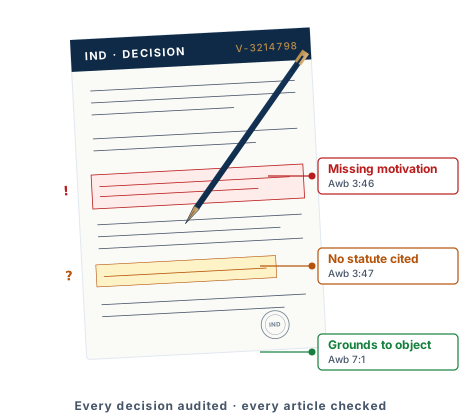
Awb 3:46 · the motivation duty, the most-cited procedural ground at the district court
Article 3:46 of the General Administrative Law Act (Awb) requires that every decision (besluit) rest on a sound, intelligible motivation (draagkrachtige motivering). The motivation duty is one of the bedrock principles of Dutch administrative law. A refusal that fails this test can be annulled in objection or court appeal on the motivation defect alone, regardless of whether the underlying decision might have been correct. In practice, motivation defects are the single most common ground on which immigration decisions are reversed at the district court (rechtbank).
Awb 3:46 · the motivation duty, the most-cited procedural ground at the district court
Awb 3:46 reads: "A decision shall rest on a sound motivation." The motivation duty is also operationalised in Awb 3:47, which requires the motivation to be communicated when the decision is announced, and Awb 4:82, which permits short-form motivation in standardised cases.
Years of district court case law have identified a recurring set of defects:
In the objection phase, the IND has the opportunity to repair motivation defects in the objection-decision. The hoor-en-adviescommissie (hearing committee) will often probe specific motivation gaps. An objection can succeed purely on a motivation defect — the IND withdraws the decision, motivates better, and either reaches the same conclusion (with better reasoning) or a different one. The substantive case may not have changed; the procedural error is enough.
At the district court, motivation defects are the single most common ground on which immigration decisions are annulled. The district court examines whether the objection decision satisfies Awb 3:46. If it does not, the decision is annulled (gegrond) and the IND is ordered to issue a new decision with better motivation. The district court can also order a court-imposed daily penalty (dwangsom) under Awb 8:55d for the new decision.
A motivation defect does not mean the applicant wins on the merits. It means the case goes back to the IND for a new decision with proper reasoning. The IND may reach the same conclusion. The motivation duty is procedural, not substantive.
The motivation duty is not directly part of the Notice-of-Default mechanism. The Notice addresses the absence of a decision, not the quality of one. However, two cross-connections matter:
The objection should set out for each specific paragraph of the IND's reasoning what specific argument or evidence was not engaged with, what specific statutory test was not applied or was misapplied, and what specific country-of-origin or factual material was ignored or treated inaccurately. The applicant's lawyer or representative compares the IND's reasoning to the case file paragraph-by-paragraph.
Substantive motivation arguments belong with a lawyer. We do not draft objection arguments. Where we touch Awb 3:46 indirectly: our Notice of Default puts pressure on the IND to decide; the decision that follows must satisfy Awb 3:46; if the resulting refusal is poorly motivated, the applicant's lawyer takes the objection route armed with the Awb 3:46 argument. Our procedural lever and the substantive objection route are complementary.