Ombudsman vs court · two routes that look similar but answer different questions
The Nationale Ombudsman and the district court are both routes for getting administrative behaviour corrected, but they answer different questions. The ombudsman addresses behoorlijkheid (proper conduct): is the IND acting with care, respect, and proportionality? The district court addresses rechtmatigheid (lawfulness): is the IND's decision in line with the statute? These are different tests, with different powers, different timelines, and different costs. Choosing the right route is the first procedural decision a migrant or their representative makes.
Ombudsman vs court · two routes that look similar but answer different questions
The Nationale Ombudsman asks: was the IND's behaviour proper? Were the deadlines respected? Was the applicant treated with care and respect? Were the procedures followed in spirit, not just in letter? Was the response time reasonable? These are behoorlijkheidstoetsen — tests of proper conduct.
The rechtbank (sector bestuursrecht) asks: was the IND's decision lawful? Did the IND apply the right statute? Did the decision rest on a sound motivation? Were the procedural rules followed? Did the evidence support the conclusion? These are rechtmatigheidstoetsen — tests of legality.
If you want behaviour corrected, the ombudsman is the route. If you want a decision overturned, the court is the route. Mixing the two leads to wasted time and missed deadlines.
| Feature | Nationale Ombudsman | Rechtbank (court) |
|---|---|---|
| Question asked | Was the conduct proper (behoorlijk)? | Was the decision lawful (rechtmatig)? |
| Standard | Behoorlijkheidsnormen (24 published norms) | Statute + general administrative principles |
| Decision power | Recommendation only | Binding judgment, can annul decisions |
| Can order a decision? | Recommendation; not binding | Yes, with court-ordered daily penalty (dwangsom) |
| Timeline | Typically 3-6 months from filing | 4-10 weeks for Awb 6:12, longer for court appeal |
| Cost | Free | €52 court filing fee for court appeal; free for Awb 6:12 |
| Pre-filing requirement | Complaint to the IND first (Awb 9:1) | Objection first for substantive court appeal; Notice of Default for Awb 6:12 |
| Lawyer needed | Optional | Strongly recommended for court appeal |
| Outcome | Published report (anonymised) | Court ruling, binding on the IND |
Both routes require an internal step first, but the steps differ:
The ombudsman is free; the court is mostly free but with a €52 court filing fee for substantive beroep (waived for low-income applicants). Both routes can be pursued without a lawyer, though a lawyer is strongly recommended for substantive court appeal. The MigrationProvision Notice-of-Default fee of €8.75 covers the upstream procedural step; the court routes that follow are funded through toevoeging (state-funded legal aid) for those who qualify.
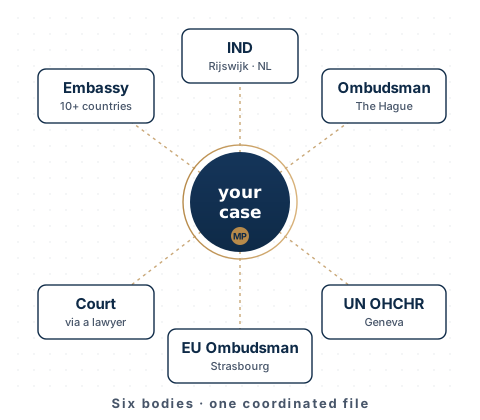
In practice, the routes can be used together. A common pattern: file the Notice of Default to open the Awb 6:12 court route; in parallel, file an ombudsman complaint on the conduct grounds. The court addresses the procedural absence-of-decision; the ombudsman addresses the broader pattern of behaviour. The two together create more pressure than either alone.
Our Notice of Default is upstream of both routes. The Notice cites the statutory term, gives the IND 14 days to decide, and creates the procedural record that both the ombudsman and the court rely on. After the Notice expires: the court route is via the lawyer (Awb 6:12 court appeal); the ombudsman route is by the applicant directly with a one-page complaint. We do not file the ombudsman complaint or the court appeal — both are downstream of our role.