The Hague, across from the Nationale Ombudsman
MPMigrationProvisionThe Hague · Administrative Justice
Statute · Awb 4:13

Every immigration decision has a statutory term, set by Awb 4:13.

Article 4:13 of the Algemene wet bestuursrecht (the General Administrative Law Act, in force since 1994) tells every Dutch authority when its decision is due. If the procedure-specific statute names a term, that term applies. If none is named, the term is what is reasonable, and the law says eight weeks is the benchmark for residual matters.

Awb 4:13 · the master clock under every Dutch administrative decision

What Awb 4:13 actually says

Two short clauses do the heavy lifting. 4:13(1): a decision shall be given within the term set by statute or, where no statute fixes a term, within a reasonable term after receipt of the application. 4:13(2): a reasonable term has in any event been exceeded after eight weeks, unless the authority has notified the applicant in writing of a longer further term under Article 4:14.

If your authority is past the term named below, the next procedural step is a Notice of Default under Awb 4:17. You do not need a lawyer to send one.

When does the clock start

Awb 4:13 reads in conjunction with Article 4:5 and 4:15. The clock starts on the date the authority receives a complete application. Three implications follow:

Procedure-specific terms

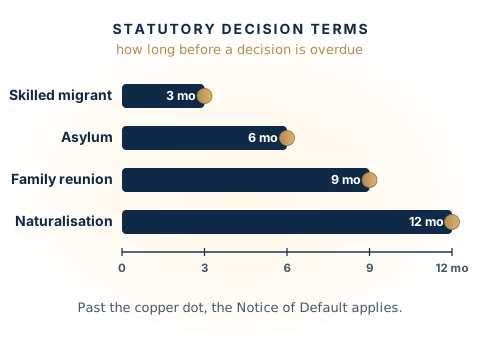
For most immigration matters a procedure-specific statute names the term. Awb 4:13 then defers to that figure. The table below lists what applies in practice.

ProcedureTermSource
Asylum, general procedure6 monthsVw 2000 art. 42 · EU Dir. 2013/32 art. 31
Family reunification (MVV / family follow-on (nareis))3 months national · 9 months EU ceilingVw 25 · EU Dir. 2003/86 art. 5(4)
Highly-skilled migrant (kennismigrant)3 monthsVw 25
Naturalisation12 monthsRWN 9(4)
Other regular residence3 monthsVw 25
Residual (no specific term)8 weeksAwb 4:13(2)

What is a complete application

Complete means: every form, fee, and supporting document the procedure requires has been filed. If anything is missing the authority will issue a request for more information (verzoek tot aanvulling) under Awb 4:5. That request suspends the clock under Awb 4:15. The moment you respond, the clock resumes. Note the inverse: a polite request for non-mandatory extra information does not suspend the clock.

What counts as a valid extension under Awb 4:14

Awb 4:14 lets the authority extend the term. It is only valid when:

Letters that say only "uw aanvraag is in behandeling" ("your application is in progress") or "het duurt wat langer" ("it is taking a little longer") are not extensions. They are status updates.

What happens when the term has passed

Once the term has expired the procedural lever is the Notice of Default under Awb 4:17. Once the authority receives it, a 14-day clock starts. If no decision arrives in those 14 days, a daily penalty (dwangsom) starts accruing, paid by the authority to you. The cap is €1,442. After 42 days the next route opens: a court appeal under Awb 6:12 against the failure to decide.

Misconceptions to retire

FAQ

Frequently asked questions.

What is Awb 4:13 in one sentence?
It is the article of Dutch administrative law that says every authority must decide within a statutory term, and if no statute names a term, within eight weeks.
Does Awb 4:13 apply to the IND?
Yes. The IND is a Dutch administrative authority. Its decisions are governed by Awb 4:13 in conjunction with the procedure-specific term in Vw 25 (residence), Vw 42 (asylum) or RWN 9(4) (naturalisation).
From which date does the term run?
From the date the authority receives a complete application. The ontvangstbevestiging (receipt) is the proof. If the application was incomplete and the authority asked for more under Awb 4:5, the clock was suspended until you responded.
What is a reasonable term if no statute names one?
The Awb says eight weeks is reasonable by default. The eight-week figure is in Awb 4:13(2). Specific procedures can require less or more, named in their own statute.
Does an extension letter restart the clock?
No. A valid extension under Awb 4:14 sets a new further date, but the clock does not restart from zero. It runs against the new date the authority committed to.
Are weekends and holidays counted?
Yes. The statutory term is in calendar days unless the source statute says otherwise. The Notice of Default's 14-day response window in Awb 4:17 is also calendar days.
What if the term passes without any letter at all?
The procedural lever opens. You may serve a Notice of Default. If no decision arrives within 14 days, the daily penalty starts. If the authority still does not decide, you can appeal to the administrative court under Awb 6:12.
Does Awb 4:13 apply to embassies abroad?
Yes, for decisions made by Dutch authorities. Long-stay visa (MVV) decisions are formally taken by the IND, even when the application is filed at an embassy. The Awb framework applies. Schengen short-stay visa decisions follow the EU Visa Code instead.
Can a court extend the term in my favour?
Courts do not extend the term against the authority. They review whether the term was respected. If it was not, the court can order a decision within a further period under Awb 8:55d.
Where can I read the original text?
Awb art. 4:13 is at wetten.overheid.nl, the official Dutch government legislation portal. We cite it verbatim in every Notice of Default we draft.
Related reading
Notice of Default (ingebrekestelling) immigrationawb 6 12 court appealdaily penalty mathwhat an extension letter doesproving your deadline passed

Past the statutory term?

We audit the receipt, the extension letter, and the calendar. If Awb 4:13 has been breached, we draft the Notice the same day.

Open a file · €8.75