ECHR Article 8 · direct effect in Dutch courts, applied without further legislation
Article 8 of the European Convention on Human Rights protects "the right to respect for private and family life". The Convention has had direct effect in the Netherlands since ratification in 1954; Dutch courts must apply it without further legislative intervention. In immigration delay, Article 8 is the single most-cited international-law argument, particularly when family members are separated across borders by an unfinished decision.
ECHR Article 8 · direct effect in Dutch courts, applied without further legislation
Article 8(1): "Everyone has the right to respect for his private and family life, his home and his correspondence." Article 8(2) lists the only grounds on which the State may interfere with that right: in accordance with the law, necessary in a democratic society, for a legitimate aim. In immigration practice the analysis follows three steps: is there family life, is the State interfering with it, is the interference justified.
In a delay case, the interference is the absence of a decision. The longer the delay, the harder it is for the State to justify it as "necessary in a democratic society".
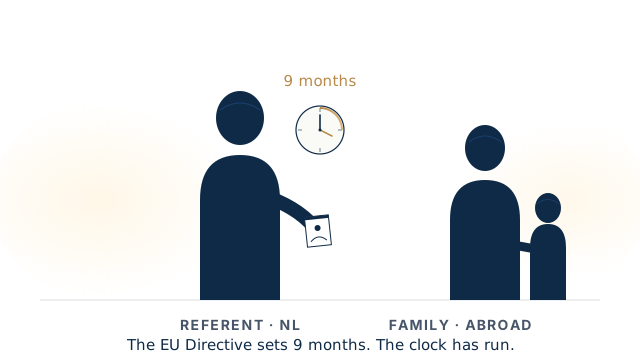
Three contexts dominate. Family reunification (MVV / family follow-on): the partner or child is abroad; the delay extends the separation. Article 8 plus EU Directive 2003/86 Article 5(4) are the standard pair. Stay during procedure: the applicant is in the Netherlands while a sponsor or family member is unable to join; Article 8 supports a request for priority or for in-country processing. Removal-and-reapply scenarios: where the IND requires departure to apply from abroad, Article 8 weighs in the proportionality assessment.
In every Notice of Default that involves family separation, the cover letter includes a paragraph on Article 8. The wording is direct: "The delay in deciding the present application engages the applicant's right to respect for family life under Article 8 ECHR. The applicant and [name relative] have been separated since [date]. The European Court of Human Rights has consistently held that prolonged uncertainty in immigration procedures involving family members can amount to an interference with Article 8 that is not necessary in a democratic society."
For the Letter of Concern to the Sector Bestuursrecht and the OHCHR submission, the Article 8 argument is the lead, supported by ICESCR Article 11 (adequate standard of living) and ICCPR Article 23 (protection of the family).
| Case | Holding |
|---|---|
| Sen v. Netherlands (2001) | Refusal of family reunification with a Turkish child was a violation of Article 8 because the parents had built family life in the Netherlands and the child could not realistically join elsewhere. |
| Tuquabo-Tekle v. Netherlands (2005) | Refusal of MVV for a 15-year-old daughter joining her mother was a violation; the State's reliance on "normal" assessment criteria did not respect the specific circumstances. |
| Jeunesse v. Netherlands (2014, Grand Chamber) | Long-term de facto stay with a Dutch family created a positive obligation to grant residence; refusal was an Article 8 violation. |
| Berisha v. Switzerland (2013) | Reverse on the facts: Article 8 was not violated where the family could continue life together in the country of origin. |
The pattern: Article 8 is fact-intensive. It is most powerful where the family cannot realistically reunite elsewhere and the State's refusal or delay is disproportionate to its administrative interest.
Article 13 ECHR guarantees an effective remedy where a Convention right has been violated. In a delay case, Article 13 is the procedural complement: the State must offer a domestic route to challenge the delay (the Notice of Default, the Awb 6:12 court appeal, the Ombudsman). When those domestic routes are exhausted or ineffective, the next step is a UN Special Rapporteur communication, citing Article 8 ECHR plus ICESCR Article 11 plus Article 13's effective-remedy guarantee.
Article 8 is not just for lawyers. We cite it routinely on Notice of Default cover letters for family-separation cases. It signals that the file knows the law and increases the chance of a fast decision within the 14-day Notice window. We do not litigate Article 8 in court; substantive Article 8 litigation goes to an admitted lawyer (advocaat). We make sure the procedural file is clean enough that, if litigation becomes necessary, it can start on day one.