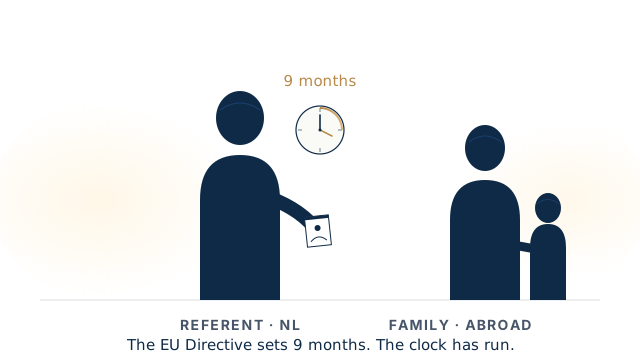
EU FRD 5(4) · 9-month ceiling overrides any longer national rule
Article 5(4) of EU Directive 2003/86 (the Family Reunification Directive) sets a maximum decision-term of nine months for family-reunification applications. The figure is a ceiling, not a target. Member States must decide within nine months; any longer term in national law is overridden. The Netherlands also has a shorter three-month term in Vw 25 for most regular permits. Both apply in parallel: whichever expires first opens the procedural lever.
EU FRD 5(4) · 9-month ceiling overrides any longer national rule
Article 5(4): "The competent authorities of the Member State shall give the person, who has submitted the application, written notification of the decision as soon as possible and in any event no later than nine months from the date on which the application was lodged. In exceptional circumstances linked to the complexity of the examination of the application, the time-limit referred to in the first subparagraph may be extended."
Nine months is the ceiling. The Court of Justice of the EU has held that the "exceptional circumstances" exception must be interpreted narrowly. Routine staffing or backlog do not qualify.
Directive 2003/86 has direct effect in the Netherlands. The Court of Justice of the EU (CJEU) confirmed in K. and A. v. Netherlands (C-153/14, 2015) that the directive's procedural guarantees, including the 9-month ceiling, are directly invokable. Dutch courts must apply Article 5(4) without further legislative intervention; the directive overrides any longer Dutch term.
| Procedure | Dutch national term (Vw 25) | EU ceiling (FRD 5(4)) | Effective term |
|---|---|---|---|
| Regular MVV family reunification | 3 months | 9 months | 3 months (Dutch shorter) |
| Nareis (asylum-derivative family reunion) | 3 months (Vw 25) | 9 months | 3 months |
| Family of EU citizens (free-movement) | Different regime: 6 months under Directive 2004/38 | Not applicable | 6 months (Free-Movement Directive) |
| Other family | 3 months | 9 months | 3 months |
In practice the Dutch 3-month term in Vw 25 is the operative deadline for most family-reunification files. The 9-month EU ceiling is the absolute backstop: even if the file is procedurally complex, no decision beyond nine months can be justified without invoking the narrow "exceptional circumstances" exception, and the CJEU has held that exception to a high bar.
Article 5(4) sub-paragraph 2 lets Member States extend the 9-month term in exceptional circumstances linked to the complexity of the examination. The CJEU in K. and A. read this narrowly: only genuine complexity (e.g. document authenticity disputes, parallel criminal proceedings) qualifies. Routine workload, sickness of staff, summer holidays and end-of-year backlogs do not. The exception must be reasoned in writing if invoked, and the applicant has a right to challenge it.
For a family-reunification file in the Netherlands, the procedural lever opens whenever the Dutch 3-month term in Vw 25 has been breached. The 9-month EU ceiling rarely comes into play because the Dutch shorter term opens the route first. The EU ceiling matters for two situations: (a) the IND argues that a longer national term applies due to a parallel proceeding, and (b) the IND invokes the exceptional-circumstances exception and the case heads to court.
Every family-reunification Notice we draft cites both Vw 25 (the operative national term) and Article 5(4) (the EU ceiling). The dual citation signals that the file is procedurally complete and discourages the IND from invoking the "exceptional circumstances" exception without genuine grounds. For cases that head to court, the EU citation strengthens the Awb 6:12 appeal and supports the parallel ECHR Article 8 argument.