Awb 4:14 · the four conditions for a valid extension
Article 4:14 of the Algemene wet bestuursrecht is the statute that lets the authority extend the term in Awb 4:13. It is the only way the IND, an embassy or a municipality can legally postpone the decision date without breaching the term. The article is short but precise: the extension must be in writing, sent before the original term expires, name a specific further date, and give a reason. Letters that miss any of the four conditions do not move the clock.
Awb 4:14 · the four conditions for a valid extension
The article reads: "Indien een beschikking niet binnen de bij wettelijk voorschrift bepaalde termijn kan worden gegeven, deelt het bestuursorgaan dit aan de aanvrager mede en noemt het daarbij een redelijke termijn waarbinnen de beschikking wel tegemoet kan worden gezien." In English: where a decision cannot be given within the statutory term, the authority shall notify the applicant and name a reasonable further term within which the decision can be expected.
Four words do the heavy lifting: in writing, before, reasonable further term, with a reason. Miss one and the extension is invalid.
| Condition | What it requires | Common failure |
|---|---|---|
| In writing | A letter addressed to the applicant, on letterhead or in Mijn IND. | Phone call or generic email without case-reference. |
| Before the original term expires | Postmark or send-date before the Awb 4:13 deadline. | Letter dated one day after the term has passed. |
| Naming a specific further date | A concrete date ("by 15 August 2026"), not a vague phrase. | "Within a few months" or "as soon as possible". |
| With a reason | A short explanation of why more time is needed. | Boilerplate "administrative reasons" or no reason at all. |
The article on what an extension letter does walks through real-world examples of each failure mode.
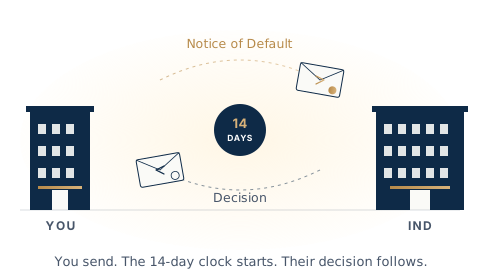
A valid extension sets a new further date. The clock does not restart from zero. It runs against the new committed date. If the authority does not decide by that new date, the same Notice of Default route is open. The daily penalty (dwangsom) calculation begins from the new date's expiry plus 14 days, not from the original term.
Awb 4:14 does not explicitly cap the number of extensions, but case-law of the Centrale Raad van Court appeal (Beroep) and the Afdeling bestuursrechtspraak van de Council of State (Raad van State) has held that repeated extensions of significant length can themselves become unreasonable under Awb 4:13. In practice: one or two extensions are common; a third extension on the same file is rarely accepted as reasonable in court.
Every Notice of Default we draft includes a one-paragraph audit of any extension letter the applicant has received. If the letter is procedurally defective, we quote the Awb 4:14 condition it fails. The IND's internal review-team is usually fast to acknowledge a defective extension and to decide on the merits, because the alternative is a court appeal that the authority will lose on the procedural point.