Request for more information · the IND request that pauses the Vw 25 or Vw 42 clock under Awb 4:15
When the IND has questions about an application or believes documents are missing, it sends a verzoek tot aanvulling (request to supplement) under Awb 4:5. This letter pauses the decision-term under Awb 4:15 from the day it is sent. The clock resumes on the day the applicant supplies the requested information. A clean response that is timely, complete, and properly documented restarts the clock and keeps the procedural lever available. A late, partial, or confused response can lengthen the procedure or even lead to the application being refused for non-cooperation. Four steps make the difference.
Request for more information · the IND request that pauses the Vw 25 or Vw 42 clock under Awb 4:15
The request for more information arrives as a letter from the IND, typically on IND letterhead, addressed to the applicant or to their mandated representative. It identifies the case by V-number and procedure reference, sets out what is missing or unclear, cites Awb 4:5 explicitly, and gives a term (often two or four weeks) for the response. The letter typically warns that failure to respond may lead to the application being declared inadmissible (niet ontvankelijk verklaard) under Awb 4:5(2).
Awb 4:15 controls when the decision-clock pauses and restarts. The pause begins on the day the IND sends the request for more information. The pause ends on the day the applicant supplies the requested information. The IND then has the remaining time within the Vw 25 / Vw 42 / RWN 9(4) clock to issue the decision.
Example. Vw 25 three-month clock. Application filed 15 January, clock ends 15 April. On 1 March (45 days in), the IND sends an aanvulling request. The clock pauses with 45 days remaining. On 15 March (14 days later), the applicant responds. The clock restarts with 45 days remaining. The new end-date is 15 March + 45 days = 29 April.
If the IND request asks for information that the applicant cannot reasonably provide, or for documents that already exist in the case file, the response should explain this and either provide what can be provided, or formally challenge the request. Refusal to respond entirely is risky; refusal with a substantive explanation of why the request is unreasonable may be defensible in objection if the IND refuses on non-cooperation grounds. A lawyer is recommended for this scenario.
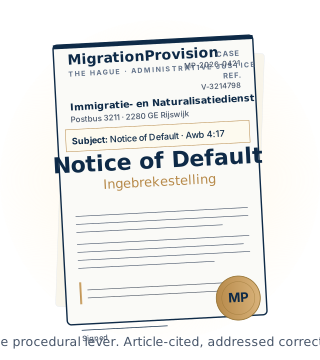
If a Notice of Default has been filed and the IND responds with an aanvulling request, the Awb 4:15 clock-pause applies and the 14-day Notice term is also paused. The IND must still decide within 14 days of receiving the applicant's response. The Awb 4:17 daily penalty calculation accounts for the pause: the daily penalty does not accrue during the pause period.
We do not draft substantive responses to aanvulling requests — that is for the lawyer or the applicant directly. We are upstream and downstream: upstream when the original Notice of Default was needed; downstream when the IND fails to decide after the response is filed. If the IND has 45 days remaining and 60 days pass without a decision, the Notice route opens again on the new clock.