Vw 25 · three months for regular residence-permit decisions
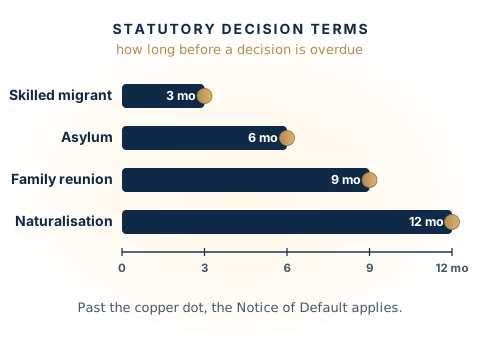
Article 25 of the Aliens Act 2000 (Vw 25) fixes the IND's decision-term on residence-permit applications at three months. This is the most-cited deadline in Dutch immigration practice. It applies to regular permits (verblijfsvergunning regulier) for highly-skilled migrant, family reunification (excluding family follow-on (nareis)), study, medical and the no-fault residence route. Vw 25 sits on top of the general administrative deadline rules in Awb 4:13 and 4:14: the three-month clock can be extended once by the IND, can be suspended under Awb 4:15, and once expired opens the Notice-of-Default route under Awb 4:17.
Vw 25 · three months for regular residence-permit decisions
Vw 25(1) reads: "The decision on an application for a residence permit shall be made within three months of receipt of the application." Vw 25(2) provides for one extension of three months, on grounds of complexity or external consultation. The total maximum decision-term is therefore six months.
What does not fall under Vw 25: asylum applications fall under Vw 42 (six months base term, extendable). MVV applications by the embassy fall under separate timelines for the embassy stage; the IND part of the procedure still follows Vw 25 once received in the Netherlands. Naturalisation falls under RWN 9(4) (twelve months).
Vw 25 is the lex specialis (special statute) for residence-permit decisions; Awb 4:13 and 4:14 are the lex generalis (general statute) that fills in the rest. Awb 4:13 establishes the principle that the statutory term defaults to eight weeks if no special term is set — here Vw 25 overrides with three months. Awb 4:14 specifies that any extension must be communicated by letter before the original term expires, identifying the new term.
The IND can extend the three-month term once, by up to three months, if the case is complex or requires external consultation. The extension must be:
The extension is not automatic. A status update is not an extension. If the IND has not sent a Vw 25(2) extension letter before the three months are up, the extension cannot be invoked retroactively.
The Vw 25 clock can be suspended under Awb 4:15 when the IND requests missing information (verzoek tot aanvulling). The clock pauses on the day the request is sent and resumes when the applicant supplies the requested documents. Internal IND processing time, DT&V consultations or third-party background checks do not count as Awb 4:15 suspension unless the IND has formally invoked the article and the applicant is on notice.
When three months (or six with extension) have passed without a decision, the applicant can send a Notice of Default (ingebrekestelling) citing Vw 25 and Awb 4:17. The IND then has 14 days under Awb 4:17(3)(a) to decide. If they do not, the daily penalty starts to run (€23/day for 14 days, €35/day for the next 14 days, €45/day for the remaining 14 days, capped at €1,442). The Awb 6:12 fictive-refusal route to court opens at the same time.
| Clock | Statute | Length | When it starts |
|---|---|---|---|
| Primary decision-term | Vw 25(1) | 3 months | Day after IND receives the application |
| Extended primary term | Vw 25(2) | +3 months | Only if extension letter sent before original term ends |
| Suspension | Awb 4:15 | Variable | When request for more information (verzoek tot aanvulling) is sent; ends when applicant responds |
| Daily penalty clock | Awb 4:17 | 14 + 14 + 14 days | Day 15 after the Notice of Default |
| Court route | Awb 6:12 | Anytime after Notice expires | Once primary clock expired and Notice served |
Vw 25 cases are the heart of our caseload. The arithmetic is simple. The application was filed; three months have passed (or six if a valid extension was sent); the Notice of Default cites Vw 25, Awb 4:17, and Awb 6:12. We file the Notice for €8.75. The IND then has 14 days to decide. If not, the daily penalty starts to run and the court route opens.