The Hague, across from the Nationale Ombudsman
MPMigrationProvisionThe Hague · Administrative Justice
FAQ · the silent authority

Silence after a Notice is not the end. It starts the next clock.

The Notice of Default opens a 14-day window. If no decision arrives within those 14 days, two things happen at once. The daily penalty (dwangsom) under Awb 4:17 begins accruing automatically. And the court route under Awb 6:12 opens, allowing a direct appeal against the failure to decide. The applicant does not need to do anything for the daily penalty to start, but does need to act to claim it and to push for a decision.

Silent authority after the Notice · Awb 4:17 + Awb 6:12 routes open

Day 14: the moment the silence costs money

If the authority does nothing within 14 calendar days of receiving the Notice, the daily penalty begins. The schedule under Awb 4:17(2):

Days after the 14-day windowRate per dayStatute
Days 1–14€23 per dayAwb 4:17(2)(a)
Days 15–28€35 per dayAwb 4:17(2)(b)
Days 29–42€45 per dayAwb 4:17(2)(c)
Day 43 onwards€0 — cap reachedAwb 4:17(2)
Cumulative cap€1,442Awb 4:17(2)
After 42 days of silence, the daily penalty cap is reached. The pressure-tool changes from money to court order.

How to claim the daily penalty

  1. 1
    Send a claim letter to the authority
    Once the term has expired, write a short letter naming the period, the daily rate, the cumulative amount, your IBAN, and a 14-day payment term. The authority is obliged under Awb 4:18 to pay within six weeks of the original Notice expiry. In practice the claim letter speeds it up.
  2. 2
    Track receipt
    Send by registered mail or via Mijn IND. Keep the proof. Most disputes about the daily penalty are date-of-receipt disputes.
  3. 3
    Wait for the payment or for the next response
    The IND usually pays the daily penalty without dispute once the claim letter arrives. If the IND argues that the Notice was procedurally defective, the response will name the defect.
  4. 4
    If unpaid, take it to the district court (rechtbank)
    An unpaid daily penalty claim, like the underlying non-decision, can be brought to court. The judge can enforce the daily penalty and add a court-imposed daily penalty on top under Awb 8:55d.

File the court appeal in parallel

The daily penalty forces money. The court appeal under Awb 6:12 forces a decision. Both run in parallel. Once the 14-day window has expired and the authority remains silent, a court appeal tegen niet-tijdig-beslissen can be filed directly at the district court, sector bestuursrecht, without first going through objection (bezwaar). See our article on Awb 6:12 for the bundle and the timeline.

What the IND typically does when it gets the Notice

What does not work

Where MigrationProvision sits

After Day 14, our system flags the file for escalation. The €12.40 escalation step pays for the daily penalty-claim letter, the court-appeal bundle preparation, and the Ombudsman complaint, all sent within the same working day. The daily penalty itself is paid by the authority to you, not to us. We never take a cut of the daily penalty.

FAQ

Frequently asked questions.

How much do I get if the authority is silent for the full 42 days?
The cap is €1,442, the sum of €23 × 14 + €35 × 14 + €45 × 14. Paid by the authority directly to you, in your bank account, taxable as miscellaneous income in box 1.
Do I need to do anything for the daily penalty to start?
No. The daily penalty under Awb 4:17 accrues automatically once the 14-day window has expired without a decision. You do need to claim it in writing for it to be paid.
When is the daily penalty paid?
Within six weeks of the expiry of the 14-day Notice window (Awb 4:18). In practice most payments arrive within four to eight weeks of a written claim letter.
Is the daily penalty taxable?
Yes. It is reported as resultaat uit overige werkzaamheden (income from other activities) in box 1 of the personal income-tax return. The amount is usually too small to push anyone into a higher bracket.
Can I file a second Notice of Default if the first is ignored?
Not for the same application. The first Notice already triggered all the statutory consequences. The next step is the court appeal under Awb 6:12 against the failure to decide.
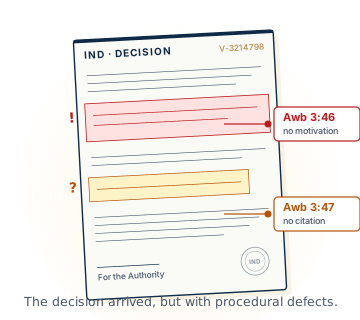
What if the authority claims the Notice was procedurally defective?
The IND occasionally argues the Notice was unclear or addressed to the wrong unit. The court reviews this in any subsequent Awb 6:12 appeal. A correctly addressed Notice with a clear statement of non-compliance is rarely successfully disputed.
Can I sue for additional damages beyond the daily penalty?
The daily penalty is a fixed-amount procedural penalty. Compensation for actual damages caused by the delay (lost income, separation harm) requires a separate civil claim. The standard is high and the cases are rare.
What if the IND decides one day before the 14-day window closes?
No daily penalty. The Notice's purpose was achieved. If the decision is negative, the right next step is bezwaar (or court appeal for asylum) on the substance.
Does the daily penalty apply at embassies?
Embassies acting on Dutch authority decisions (MVV) are governed by the Awb. The daily penalty applies but in practice the IND, not the embassy, is the formal addressee. The Notice goes to the IND.
Will future applications be affected?
No. The daily penalty is not a fine against the applicant. It is the authority paying for missing its own deadline. Future applications are processed normally.
Related reading
Notice of Default (ingebrekestelling) immigrationdaily penalty mathawb 6 12 court appealawb 4 13 explainedwhat an extension letter does

Past the 14-day window?

We prepare the daily penalty-claim letter, the court-appeal bundle and the Ombudsman complaint. €12.40 for the escalation step. The daily penalty is paid to you, not to us.

Open a file · €8.75