The Hague, across from the Nationale Ombudsman
MPMigrationProvisionThe Hague · Administrative Justice
FAQ · the clock question

Sending the Notice does not buy the authority more time. It starts a faster, shorter clock.

A common worry among applicants: "if I send a Notice of Default, won't that give the IND another six weeks to decide?" No. The original Awb 4:13 term has already passed; that is the precondition for sending the Notice in the first place. What the Notice does is start a second, 14-day clock under Awb 4:17(3). At the end of that second clock, the daily penalty begins. The original term does not reset.

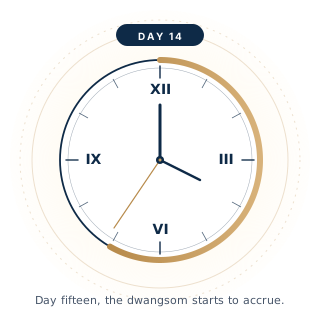
The Notice starts a new 14-day clock · the original term does not reset

The two clocks, in order

There are two clocks in play, and they are sequential, not alternative.

ClockLengthStatuteWhat it does
Clock 1: the statutory termProcedure-specific (3, 6, 9, 12 months)Awb 4:13 + Vw 25 / Vw 42 / RWN 9(4)The authority must decide within this period.
Clock 2: the Notice window14 daysAwb 4:17(3)If no decision arrives, the daily penalty begins.
Clock 3: the daily penalty42 days, capped at €1,442Awb 4:17(2)Daily penalty accrues automatically.
Clock 4: the court routeOpen after the daily penalty capAwb 6:12Direct court appeal against the failure to decide.
The Notice does not pause anything. It starts the next clock in a chain that ends in money owed and a court order.

Why the confusion exists

Three reasons, all real but all incorrect when examined.

What the Notice actually does

  1. 1
    Documents that the term has expired
    The Notice is the written record that the applicant has noted the breach. Without it, the authority has no formal warning and the daily penalty does not start.
  2. 2
    Triggers the IND's internal escalation
    Most stuck files are pulled forward by an internal IND team as soon as a Notice arrives. About 7 in 10 cases get a decision within the 14-day window.
  3. 3
    Starts the 14-day daily penalty clock
    Day 1 of the 14 begins on the date the authority received the Notice. Day 15 is the first day the daily penalty accrues at €23/day.
  4. 4
    Opens the court route
    After the 14 days expire and a reasonable further period (case-law: ~2 weeks), the court appeal under Awb 6:12 is available without going through objection.

Edge cases

So, definitively

Sending a Notice of Default does not give the authority more time. It starts a separate, 14-day procedural clock that ends in financial consequence. The original statutory term has already been breached; the Notice is the procedural response to that breach. Once the 14-day window expires without a decision, the daily penalty begins automatically and the court route opens.

Where MigrationProvision sits

Every Notice we draft cites Awb 4:13 (the breached term) plus Awb 4:17 (the 14-day window) plus the procedure-specific source (Vw 25 / Vw 42 / RWN 9(4)). This makes the two-clocks structure explicit on the face of the letter, which discourages the authority from arguing in subsequent correspondence that the Notice was procedurally unclear.

FAQ

Frequently asked questions.

Will the Notice of Default give the IND another six weeks?
No. The Notice gives the authority 14 days under Awb 4:17(3) to decide, on top of an already-breached term. It does not restart or extend the original term in Awb 4:13.
Does sending the Notice pause anything?
No. Awb 4:17 starts a new 14-day clock; it does not pause Awb 4:13. The original term has already been breached.
What does the 14-day window mean exactly?
If the authority decides within 14 days of receiving the Notice, no daily penalty is owed. If it does not, the daily penalty accrues from day 15 onward.
Can the authority send another extension after my Notice?
Yes, under Awb 4:14, but only if the letter meets the four validity conditions (in writing, before the relevant deadline, specific further date, with a reason). Most "status updates" do not.
If the IND extends after my Notice, does the daily penalty start when the new date passes?
Yes. A valid Awb 4:14 extension during the 14-day window sets a new committed date. The daily penalty starts only if the authority misses the new date.
Will the IND treat me worse for sending a Notice?
No. The Notice is a procedural right. See the dedicated article. Internal IND documentation does not allow worse treatment of applicants who exercise procedural rights.
Can I send the Notice early, before the term has passed?
No. The Notice can only be served once the statutory term has actually expired. A premature Notice is procedurally defective and the authority can ignore it.
Does the Notice count as a substantive complaint about my case?
No. The Notice is procedural only. Substantive complaints about a refused or incorrect decision go through objection / court appeal under Awb 7:1 / 8:1.
What if the 14 days have passed and still no decision?
The daily penalty begins automatically. Send the daily penalty-claim letter and open the court route under Awb 6:12. See our dedicated article.
Where can I read the original text?
Awb art. 4:13 and 4:17 are at wetten.overheid.nl. Both are short and quoted in every Notice we draft.
Related reading
Notice of Default (ingebrekestelling) immigrationawb 4 13 explainedawb 4 17 daily penalty explainedawb 4 14 extension letterwill it hurt my case

Worried the Notice will buy the IND more time?

It does the opposite. The Notice starts a faster, shorter clock with money at the end. €8.75 to open a file.

Open a file · €8.75