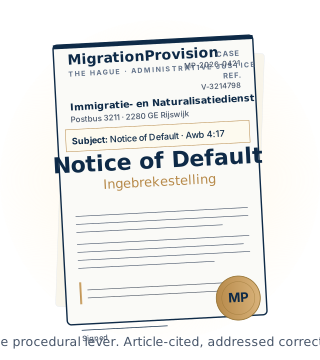
The Notice of Default · one page, seven elements, registered mail
A Notice of Default (Ingebrekestelling) is a formal letter that tells the authority it has missed its statutory decision term. The Awb does not require it to be in legalese. Seven elements are required, in any order, and the letter must reach the authority by a method that produces proof of delivery. Once received, a 14-day clock starts under Awb 4:17(3) and the daily penalty mechanism comes online.
The Notice of Default · one page, seven elements, registered mail
The Notice does not need to argue the merits of the application. It is a procedural lever, not a brief. The argument is: the term has passed; you have 14 days; here is the statute.
| Authority | Address |
|---|---|
| IND (most procedures) | Immigratie- en Naturalisatiedienst, Postbus 3211, 2280 GE Rijswijk |
| IND asylum | IND Aanvraagcentrum Zevenaar / Schiphol / Ter Apel, address per the acknowledgement letter |
| Dutch embassy MVV | The IND, not the embassy. MVV decisions are formally taken by the IND. |
| Municipality (BRP) | The college van burgemeester en wethouders, attn. afdeling Burgerzaken, of the municipality |
| Naturalisation | Same as IND regular: Postbus 3211, 2280 GE Rijswijk |
Most stuck cases resolve within the 14-day Notice window. Internal IND escalation routes pull the file forward as soon as the Notice arrives. About 7 in 10 files get a decision in those 14 days. The rest either receive a valid Awb 4:14 extension (the clock resets to the new committed date) or fall into the daily penalty + court-appeal route.
Drafting a Notice yourself takes about 90 minutes if you are familiar with the conventions. We do it in 24 hours for €8.75, including the address audit, the V-number check, the Awb 4:14 extension audit, and the registered-mail postage. The letter we produce is the one that has worked across thousands of IND cases.