The Hague, across from the Nationale Ombudsman
MPMigrationProvisionThe Hague · Administrative Justice
How-to · the Notice itself

Writing a Notice of Default is a one-page job with seven elements.

A Notice of Default (Ingebrekestelling) is a formal letter that tells the authority it has missed its statutory decision term. The Awb does not require it to be in legalese. Seven elements are required, in any order, and the letter must reach the authority by a method that produces proof of delivery. Once received, a 14-day clock starts under Awb 4:17(3) and the daily penalty mechanism comes online.

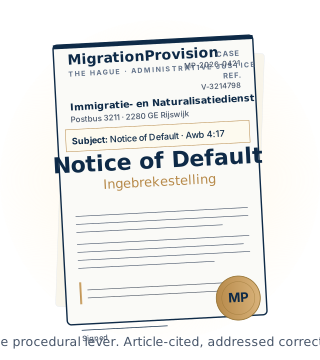
The Notice of Default · one page, seven elements, registered mail

The seven elements every Notice must contain

  1. 1
    Sender block
    Your full name, address, date of birth, and (for IND files) your V-number. The authority must be able to identify the underlying case without further enquiry.
  2. 2
    Addressee block
    The correct authority and the correct unit within it. For IND files, the unit named in your ontvangstbevestiging plus the IND's postbus address (typically Postbus 3211, 2280 GE Rijswijk). The wrong unit can be a procedural defence the authority later raises.
  3. 3
    Subject line
    Plain: "Notice of Default (Ingebrekestelling) op grond van artikel 4:17 Awb". The IND's mailroom routes by subject line; an unclear subject delays delivery.
  4. 4
    Reference to the application
    Date the application was received by the authority, the application reference number, and the procedure type (e.g., "aanvraag residence permit (verblijfsvergunning) regulier ex Vw 25"). Without this the authority cannot match the Notice to the file.
  5. 5
    Statement that the statutory term has expired
    One sentence: "De wettelijke decision term (beslistermijn) van [X] maanden is op [date] verstreken zonder beschikking." If applicable, also note any extension under Awb 4:14 and whether you accept it as valid.
  6. 6
    Formal notice and the 14-day window
    "Hierbij stel ik uw bestuursorgaan formeel in gebreke. U beschikt over een termijn van veertien dagen na ontvangst van deze brief om alsnog een beschikking te geven, op straffe van een daily penalty als bedoeld in artikel 4:17 Awb."
  7. 7
    Signature and date
    Wet signature (not typed) and the date. If filed by a representative, attach the mandate (volmacht).
The Notice does not need to argue the merits of the application. It is a procedural lever, not a brief. The argument is: the term has passed; you have 14 days; here is the statute.

Where to send it

AuthorityAddress
IND (most procedures)Immigratie- en Naturalisatiedienst, Postbus 3211, 2280 GE Rijswijk
IND asylumIND Aanvraagcentrum Zevenaar / Schiphol / Ter Apel, address per the acknowledgement letter
Dutch embassy MVVThe IND, not the embassy. MVV decisions are formally taken by the IND.
Municipality (BRP)The college van burgemeester en wethouders, attn. afdeling Burgerzaken, of the municipality
NaturalisationSame as IND regular: Postbus 3211, 2280 GE Rijswijk

How to send it

What the IND typically does

Most stuck cases resolve within the 14-day Notice window. Internal IND escalation routes pull the file forward as soon as the Notice arrives. About 7 in 10 files get a decision in those 14 days. The rest either receive a valid Awb 4:14 extension (the clock resets to the new committed date) or fall into the daily penalty + court-appeal route.

Common drafting mistakes

Where MigrationProvision sits

Drafting a Notice yourself takes about 90 minutes if you are familiar with the conventions. We do it in 24 hours for €8.75, including the address audit, the V-number check, the Awb 4:14 extension audit, and the registered-mail postage. The letter we produce is the one that has worked across thousands of IND cases.

FAQ

Frequently asked questions.

Do I need a lawyer to write a Notice of Default?
No. The Notice is a procedural letter, not a legal brief. The Awb does not require legal representation. Most applicants write it themselves or use a service like ours.
How long does the Notice need to be?
One page is enough. Two if you include a paragraph on Article 8 ECHR (family separation) or other rights arguments.
In what language must the Notice be?
Dutch is the safe default. English is sometimes accepted by the IND but a Dutch text is procedurally unchallengeable. We send Dutch + English in parallel.
Can I send the Notice by email?
Not recommended. Most IND units deny legally binding service by email. Use PostNL Aangetekend or Mijn IND.
Where do I find the correct IND address?
The ontvangstbevestiging (acknowledgement) names the IND unit handling your file. Use that unit's address plus the IND's central postbus. We maintain the address list internally.
How long until the 14-day clock starts?
It starts on the day the authority receives the Notice. PostNL Aangetekend delivery is typically next business day in the Netherlands.
What if the IND ignores the Notice?
After the 14 days expire, the daily penalty begins automatically. The next step is the daily penalty-claim letter plus the court appeal under Awb 6:12. See our dedicated article.
Can the Notice be sent by a third party on my behalf?
Yes, with a written mandate (volmacht). MigrationProvision sends Notices under a one-page mandate signed by the applicant.
What if I make a mistake in the Notice?
A minor error usually does not invalidate it (case-law: "hersteltheorie"). A major error (wrong addressee, no 14-day notice, no statute citation) can be challenged by the authority.
Is there a model Notice I can copy?
We do not publish a model on the website because the address and the case-reference vary. Open a file at €8.75 and we produce yours, fully audited, within 24 hours.
Related reading
Notice of Default immigrationawb 4 13 explainedawb 4 17 daily penalty explainedawb 4 14 extension letterwhat happens if the authority ignores the notice

Ready to write the Notice?

We draft a fully audited Notice in 24 hours for €8.75 and post it by registered mail. The 14-day clock starts the next business day.

Open a file · €8.75